The 2026 sterile packaging landscape is becoming more demanding. Dispensing syringes need protection before use, during transport, and at the point of application. Their packaging must preserve sterility without damaging barrels, plungers, tips, or sensitive formulations.
So, why is sterile packaging essential for dispensing syringes? A reliable sterile barrier limits microbial contamination and protects the device from moisture, particles, and handling damage. It also supports controlled opening in cleanroom, laboratory, and clinical environments. Common solutions include rigid trays, thermoformed blisters, peelable pouches, and Tyvek-lidded systems. Each option creates different risks. A sharp syringe tip can puncture a flexible pouch. Excessive sealing heat can distort polymer components. Small failures matter.
Industry evidence supports this direction. Grand View Research’s 2024 sterile packaging analysis identifies healthcare demand, biologics, and stronger contamination controls as important market drivers. Smithers’ The Future of Global Healthcare Packaging to 2029 also emphasizes material performance, sustainability, and supply-chain resilience. MarketsandMarkets’ 2024 prefilled syringes market report indicates continued growth through 2030, increasing pressure on packaging consistency and production capacity.
Standards provide the foundation. ISO 11607 requires packaging systems to maintain sterility until the point of use. ASTM testing can evaluate seal strength, package integrity, and distribution damage. Yet no package wins every application. A cost-efficient pouch may not suit a fragile dispensing tip. The best 2026 choices will balance barrier protection, usability, validation evidence, recyclability, and real transport conditions. That balance is easy to underestimate.
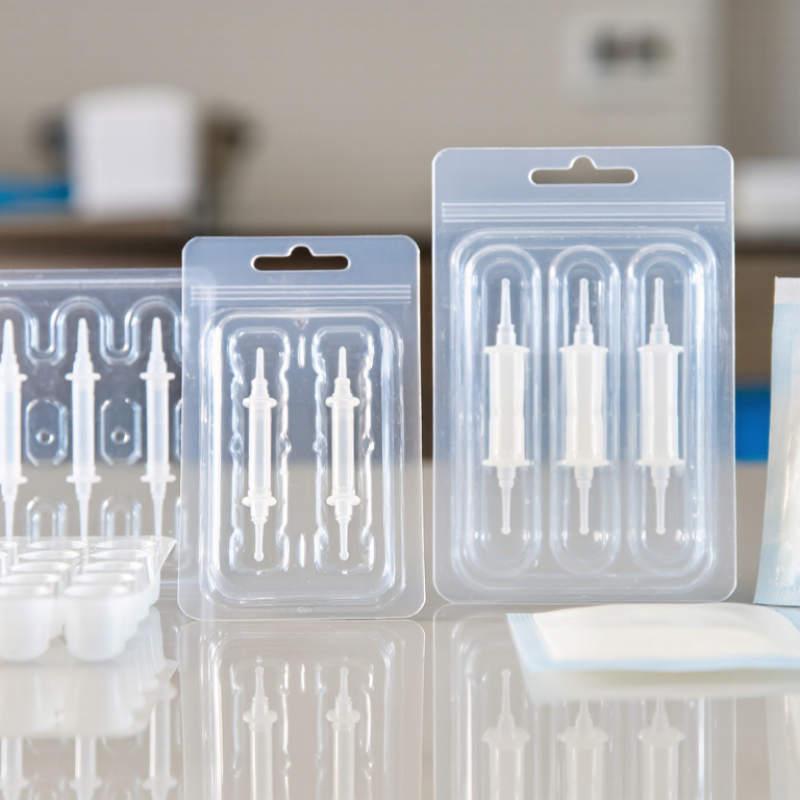
Top 2026 Sterile Packaging for Dispensing Syringes?
Sterile dispensing-syringe packaging must protect the device before use. ISO 11607 focuses on forming, validating, and maintaining the sterile barrier. For syringes, the package should protect the tip, plunger, flange, and barrel from damage. A rigid tray with a peelable lid can control movement during transport. A medical-grade pouch may suit lighter configurations. The choice depends on geometry and handling.
SAL 10^-6 is a critical sterilization target for many terminally sterilized medical devices. It means the validated process supports no more than one surviving microorganism per million sterilized units. Packaging does not create sterility. It must tolerate the selected sterilization method and preserve the barrier afterward. Materials need evidence for seal strength, microbial barrier performance, and compatibility with radiation, steam, or ethylene oxide processes. ISO 11607 testing should include real-time or accelerated aging, distribution simulation, and package integrity checks.
Details matter. A sharp syringe edge can puncture a pouch during vibration testing. An overly strong seal can tear the lid and expose fibers. Seal width, opening force, and protective spacing deserve measurement, not assumptions. The practical lesson is less tidy. A package can pass one test and still show weakness after aging. This is why production samples, transport evidence, and documented process controls matter. In the laboratory, results may look clean. Actual operators can introduce different stresses. Human handling deserves validation too.
ISO 11607 focuses on designing and validating packaging systems that maintain sterility through sterilization, handling, storage, and distribution. The chart shows the mathematical sterility-assurance benchmark represented by different SAL values. A SAL of 10⁻⁶ corresponds to a maximum probability of one nonsterile unit in one million sterilized units; packaging validation does not replace sterilization-process validation.
For dispensing syringes, format choice should follow barrier risk, not appearance.
Pouches offer efficient material use and simple sealing. They suit syringes with moderate moisture and oxygen sensitivity. However, sharp tips or rigid components may create puncture risks. Blisters provide cavity protection and product visibility. Their formed structure reduces movement during transport. Trays offer stronger mechanical protection for fragile or preassembled syringes. Yet, trays often require more material and larger shipping space. The real barrier comes from the film, foil, lid, and seal design. Format alone cannot guarantee sterility.
Grand View Research estimated the global medical device packaging market at about US$29.6 billion in 2023. Its report projects roughly 6.5% annual growth through 2030.
This growth supports more specialized sterile formats, but cost pressure remains. ISO 11607 requires packaging systems to maintain sterility until use. In practice, seal strength, puncture resistance, and distribution testing deserve equal attention. I have seen teams over-specify barrier films while overlooking needle movement. That is an expensive blind spot. No format is perfect.
Tips:
Map the syringe’s moisture, oxygen, light, and puncture risks first. Choose a pouch for flexible efficiency, a blister for visibility, or a tray for rigid protection. Test the complete system under aging and transport conditions. A sterile barrier can pass initial testing and still fail after months. Review seal width, opening force, and user handling. Small details matter.
Selecting sterile packaging for dispensing syringes in 2026 requires more than choosing a strong pouch or tray. The material must protect sterility, tolerate handling, and support reliable opening in clinical settings. Medical-grade spunbonded polyolefin provides high microbial barrier performance and controlled breathability. It can suit porous lids and flexible pouches, but seal quality remains critical.
PETG offers clarity and impact resistance, making it useful for trays where visual inspection matters. It may require careful control of forming temperature and wall thickness. COP provides low moisture absorption, strong dimensional stability, and excellent chemical resistance. Its cost can be higher, so the design should justify that performance. Small leaks matter.
Moisture and oxygen control should be evaluated with the actual syringe, closure, and sterilization process. A package that performs well in a dry laboratory may behave differently after transport humidity, compression, or repeated temperature changes. Use seal-strength testing, dye-leak checks, microbial barrier studies, and accelerated aging before selecting a final structure. Oxygen transmission and water vapor transmission rates should match the product’s sensitivity, not a generic specification.
Real packages are not perfect. Minor channel defects, sharp tray edges, or uneven sealing can weaken an otherwise advanced design. I would also challenge overly aggressive barrier choices, because extra layers can complicate recycling, forming, and opening. The best structure balances protection, manufacturability, inspection, and practical handling evidence.
Top 2026 Sterile Packaging for Dispensing Syringes?
Sterilization compatibility should guide sterile packaging decisions for dispensing syringes. The package must protect sterility while tolerating the selected process. It also needs evidence, not optimistic assumptions.
EtO sterilization can suit heat-sensitive syringe assemblies and flexible pouches. Validation should document temperature, humidity, exposure time, and residual limits. Biological indicators provide useful process evidence. However, trapped EtO can remain a concern. Packaging volume and material density may change aeration performance. Small details matter.
Gamma sterilization offers strong penetration and consistent treatment across packaged loads. Dose mapping should confirm minimum and maximum absorbed doses. The lower dose must support sterility assurance. The higher dose must not weaken seals, films, or syringe components. Color changes and polymer embrittlement deserve inspection after irradiation and aging. Gamma is predictable, but not harmless to every material.
E-beam processing is fast and leaves little time for thermal exposure. Its limited penetration makes carton arrangement and package thickness critical. Dose records should include mapping, load configuration, and routine dosimeter checks. A package can pass initial testing yet fail after accelerated aging. That failure is easy to overlook.
A practical 2026 specification should connect sterilization dose evidence with seal strength, leak testing, visual inspection, and distribution simulation. Testing only new samples is insufficient. Real-world handling is rougher than a laboratory bench. I would also challenge “worst case” claims unless the load design clearly proves them. Evidence should remain traceable, repeatable, and open to review.
| Packaging Configuration | Typical Material Structure | EtO Compatibility | Gamma Compatibility | E-Beam Compatibility | Typical Sterilization Evidence | Main Technical Considerations |
|---|---|---|---|---|---|---|
| Peelable sterile pouch | Medical-grade porous paper or coated nonwoven on one side; transparent polymer film on the other side | Recommended Good gas penetration when the pouch is not tightly compressed. |
Conditional Film and seal performance must be verified at the selected dose. |
Conditional Suitable when the film, adhesive, and seal system are qualified for electron-beam exposure. |
EtO cycle validation under ISO 11135; package integrity and seal-strength testing under ISO 11607-1 and ISO 11607-2. | Control pouch loading, air removal, humidity, seal temperature, seal width, and seal-channel defects. Prevent syringe flange or tip geometry from damaging the film. |
| Form-fill-seal blister | Thermoformed polymer cavity with a porous or polymeric lidding material | Recommended Allows effective gas access when the cavity and lid design are properly vented. |
Conditional Polymer discoloration, embrittlement, and dimensional change require dose testing. |
Conditional Higher sensitivity to dose rate and material thickness may require process optimization. |
Validated microbial lethality, bioburden monitoring, sterility testing, seal integrity, dye penetration, burst testing, and distribution simulation. | Useful for protecting syringe tips and plungers. The cavity must prevent movement that could stress the sterile barrier during transportation. |
| Rigid tray with lidding | Thermoformed or injection-molded polymer tray with porous, coated, or polymeric lid | Recommended Good product protection and generally suitable for gas sterilization. |
Conditional Tray wall thickness, lid material, and polymer chemistry influence dose tolerance. |
Conditional Requires confirmation of dose uniformity throughout the loaded tray. |
Packaging validation to ISO 11607; sterilization validation to ISO 11135 or ISO 11137; transportation testing using a defined distribution profile. | Provides stronger mechanical protection than a pouch but can increase package volume and sterilization dose-shadowing risk. |
| Polyolefin film pouch | Multilayer polyethylene or polypropylene film with a compatible porous header or lidding layer | Recommended Usually compatible with EtO when the package supports gas diffusion and aeration. |
Conditional Often usable, but optical changes, oxidation, and seal degradation must be evaluated. |
Conditional Generally feasible at validated doses, subject to film thickness and additive compatibility. |
Material characterization before and after sterilization, package aging, seal-strength retention, microbial barrier testing, and EtO residual testing where applicable. | Low extractable risk varies by formulation. Avoid excessive film tension and sharp syringe features that may puncture the pouch. |
| Polyester-based high-barrier pouch | Polyester or coated polyester film laminated to a heat-sealable polymer layer, often with a porous or lidding component | Recommended Suitable when the complete laminate supports gas exchange and validated aeration. |
Recommended Good dimensional stability; adhesive and seal-layer radiation resistance must be verified. |
Conditional Usually workable, but laminate yellowing, embrittlement, and seal-strength retention require testing. |
Gamma or e-beam dose mapping, pre- and post-sterilization seal testing, accelerated aging, real-time aging, and visual inspection. | High barrier can reduce moisture and gas transmission. Do not assume that a high-barrier structure is automatically suitable for EtO processing. |
| COC or COP syringe tray and lidding system | Cyclic olefin copolymer or cyclic olefin polymer tray with compatible lidding film | Recommended Commonly suitable for EtO if the package permits adequate gas penetration and aeration. |
Conditional Requires evaluation of optical change, brittleness, dimensional stability, and extractables. |
Conditional Requires dose mapping and product-performance testing across the selected dose range. |
Container-closure or sterile-barrier validation, dimensional inspection, particulate evaluation, aging, distribution simulation, and sterilization residual assessment. | Useful where visibility, low moisture absorption, and dimensional precision are important. Radiation response depends on grade and additives. |
| Polypropylene tray or pouch system | Medical-grade polypropylene structure with heat-sealable film or lidding | Recommended Generally suitable for EtO when the system provides gas access and controlled aeration. |
Conditional Potential oxidation, discoloration, embrittlement, or seal-strength loss must be assessed. |
Conditional Radiation stabilizers and the selected dose can strongly affect performance. |
Material aging, tensile and seal-strength retention, package integrity, dose-range exposure, bioburden, and sterility testing. | Suitable for robust handling, but formulation-specific radiation resistance should never be inferred from polymer type alone. |
| Tyvek-type nonwoven header with transparent film | High-density polyethylene nonwoven header combined with a heat-sealable transparent polymer film | Recommended High gas permeability supports EtO sterilization when the full package is correctly configured. |
Conditional Film, ink, adhesive, and seal-layer performance require gamma dose confirmation. |
Conditional Usually possible, subject to dose mapping and seal-integrity verification. |
Porous sterile-barrier characterization, seal validation, microbial barrier testing, visual inspection, aging, and sterilization-cycle validation. | Do not use printed areas, folds, or creases as the sole basis for gas or microbial-barrier performance. Maintain a controlled seal area. |
Top 2026 Sterile Packaging for Dispensing Syringes?
For dispensing syringes, sterile packaging validation must connect test results with real handling risks. USP <1207> provides the framework for package integrity, including deterministic and probabilistic methods. A practical protocol should define critical seals, closure interfaces, and likely damage points before testing begins.
ASTM F88 measures seal strength through a controlled peel test. It shows whether seals resist opening, shipping stress, and routine handling. However, high strength does not always prove package integrity. ASTM F1929 uses dye penetration to detect channels in porous packaging materials. Inspectors should control dye exposure, lighting, and operator training. Small leaks can hide along uneven seal areas.
ASTM F1980 supports accelerated aging studies for sterile barrier systems. Teams use temperature-based models to estimate shelf life, then confirm results with real-time aging. The model depends on assumptions about material stability and reaction rates. Those assumptions can be wrong. Keep samples from different production lots, and record seal temperature, pressure, and dwell time. Physical damage testing should reflect syringe distribution, including vibration, compression, and drops. Document every failure with photographs and measured locations. A passing dye test may still miss a closure problem. Validation becomes stronger when USP <1207> principles guide the entire evidence chain, rather than serving as a final checklist.
Select it according to moisture, oxygen, light, movement, and puncture risks. Appearance is not enough.
A pouch uses materials efficiently and seals simply. It suits syringes with moderate barrier needs. Sharp tips can puncture it.
Blisters create individual cavities and show the syringe clearly. Their formed shape limits movement during transport.
Trays offer stronger mechanical protection for fragile or preassembled syringes. They may increase material use and shipping volume.
No. Sterility depends on the film, lid, foil, seal, and complete package design. Format alone is insufficient.
Consider microbial protection, clarity, impact resistance, moisture absorption, chemical resistance, and dimensional stability. Small leaks matter.
Seal-strength testing measures peel performance. Dye testing can reveal channels. Accelerated aging estimates shelf life.
Yes. Transport humidity, compression, vibration, temperature changes, and sharp edges may create later damage. Initial success is not permanent proof.
Record seal width, temperature, pressure, dwell time, opening force, production lot, and damage location. Photographs help.
Match barrier performance to the syringe’s real sensitivity. Extra layers may complicate forming, opening, inspection, and recycling. The “strongest” design is not always the best.
Why is sterile packaging essential for dispensing syringes? It protects the device and its contents from microbial contamination, moisture, oxygen, particles, and physical damage throughout sterilization, storage, transport, and use. A suitable packaging system should support ISO 11607 requirements and help achieve a sterility assurance level of 10⁻⁶. In 2026, pouches, blisters, and trays can be selected according to barrier performance, handling needs, presentation, and protection required during distribution.
Material selection should consider porous medical-grade barrier materials, clear polymer films, thermoformed PETG, cyclic olefin polymer, and multilayer structures designed for moisture and oxygen control. Compatibility with ethylene oxide, gamma irradiation, or electron-beam sterilization must be demonstrated through dose evidence and package integrity testing. Validation may include microbial barrier and seal-strength assessments using USP <1207>, ASTM F88, and ASTM F1929, while ASTM F1980 supports accelerated aging studies. Together, these evaluations confirm that the packaging maintains sterility, functionality, and usability throughout its intended shelf life.

Nexus Medical