Choosing a medical tape sounds simple. Then a red, itchy outline appears beneath the dressing. What materials are used in hypoallergenic medical tapes, and which parts touch the skin? The answer depends on the product: “hypoallergenic” does not describe one universal formula.
Many tapes pair a backing—such as soft nonwoven fabric, paper, or thin polyurethane film—with a pressure-sensitive adhesive. Silicone adhesives are often chosen for gentle removal; some products use modified acrylic adhesives. Formulations vary, so the label alone cannot identify every ingredient or predict an individual reaction. Latex-free also does not mean allergy-proof.
Contact-dermatitis specialist Dr. Peter Schalock’s clinical work highlights the importance of identifying the specific allergen. A cautious summary of that principle—not a verbatim quotation—is: “A product label cannot replace careful attention to the individual patient’s sensitivities.” That distinction matters when tape is worn for hours, pressed over fragile skin, or repeatedly removed. A strip may feel soft yet still cause irritation.
This guide examines backing materials, adhesive types, and practical labeling clues. It also explains why “hypoallergenic” should be read as a risk-reduction claim, not a guarantee. Small details matter: the adhesive chemistry, the skin condition, and the length of wear can all change comfort. When reactions recur, a clinician can help assess possible causes and alternatives.
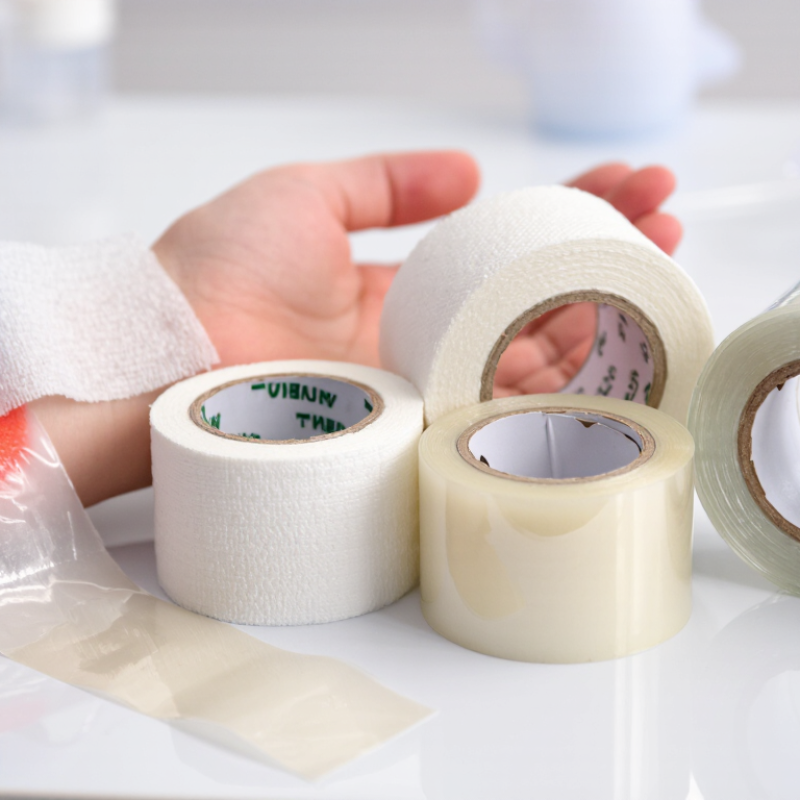
The backing controls how a tape bends, breathes, and follows skin. Common options include soft nonwoven fabrics, paper, woven cloth, and thin polyurethane film. A nonwoven backing can feel light against a curved wrist, while film may provide a barrier to moisture. No single backing suits every patient or dressing. Fit matters.
The adhesive is often silicone, acrylic, or synthetic rubber. Silicone can support gentler removal, while acrylic formulations are commonly selected for longer wear. “Hypoallergenic” does not mean reaction-proof; skin condition, wear time, and removal technique also matter. A 2013 Journal of Wound, Ostomy and Continence Nursing consensus review reported medical adhesive-related skin injury rates of 3.4%–25.3% across clinical settings. The wide range reflects differing patients and methods, so it should not be treated as a universal risk estimate. The release liner, usually coated paper or polyester, protects the adhesive before use and should peel away cleanly without stretching the tape.
Tips: Check the backing’s breathability and the adhesive’s intended wear time. Apply to clean, dry skin, and remove slowly while supporting the skin. Small details matter. A patch test may help identify sensitivity, but it cannot guarantee a reaction-free result.
Nonwoven fabric feels soft and conforms to elbows, knuckles, and other moving areas. Its porous structure allows air to pass through, while the fibrous surface can make removal less smooth on fragile skin. Polyurethane film is thin, transparent, and flexible. It forms a barrier against water, yet its breathability depends on the film’s design and thickness. Polyethylene film is also lightweight and moisture-resistant, but it is generally less conformable and less breathable than many polyurethane films. Feel the difference.
The backing is only part of the skin-contact system. Adhesive chemistry, wear time, skin condition, and removal technique also affect irritation risk. A 2013 review by McNichol and colleagues reported medical adhesive-related skin injury rates from 3.4% to 25% across the studies it examined; settings and measurement methods varied. That range is a reminder: “hypoallergenic” does not guarantee a reaction-free experience.
For selection, compare real-use details, not just material names. Check whether the tape stretches with movement, whether moisture builds beneath it, and whether its edges lift on curved skin. Grand View Research’s medical-tapes market report estimated the global market at about US$2.5 billion in 2023, but market size says nothing about an individual tape’s skin tolerance. Clinicians should follow product instructions and assess skin during wear, especially for patients with fragile or previously irritated skin.
Hypoallergenic medical tapes use different adhesive chemistries, and “hypoallergenic” does not mean allergy-proof. Silicone adhesives are soft and flexible. They often lift with less force, which can help when skin is fragile or a dressing needs frequent changes. Acrylic adhesives usually provide firmer, longer-lasting attachment. Their performance depends on the formula and wear conditions, not just the adhesive name. Hydrocolloid adhesives contain absorbent particles, such as carboxymethylcellulose, within an adhesive matrix. With moisture, they can form a gel-like layer against the skin. No option is perfect.
A 2022 systematic review of adult intensive-care studies reported a pooled medical adhesive-related skin injury prevalence of 19.7%. That figure describes a high-risk care setting; it is not a rate for every tape user. It does underline why removal matters. In practice, clinicians consider skin condition, sweat, movement, wear time, and how often tape must be changed. A silicone tape may release gently but need extra support on a damp, moving limb. Acrylic may hold well, yet cause discomfort if pulled off quickly. Hydrocolloid can suit some moist sites, but its bulk and gel residue may be inconvenient. Test a small area when appropriate, and reassess redness, pain, or blistering after removal. Formulations vary, so material labels alone cannot predict an individual reaction.
Common adhesive families include silicone, acrylic, and hydrocolloid formulations.
Each bar maps a tape formulation to its defining adhesive family: 1 means “this is the named family,” and 0 means “it is not.” These are categorical markers, not percentages or measures of allergy risk. Actual formulations vary; “hypoallergenic” does not guarantee that a product will not cause a reaction.
Hypoallergenic medical tapes may use silicone or acrylic adhesives, paired with backings made from nonwoven fabric, polyurethane film, or paper. No material is automatically gentle for every person. The complete tape matters: adhesive ingredients, backing, processing residues, and contact time can all affect skin response.
ISO 10993-23:2021 addresses irritation, such as localized redness or swelling after contact. ISO 10993-10:2021 addresses sensitization, an immune response that can develop after exposure and may appear later. These are distinct endpoints. A test for one does not replace the other. Testing plans should consider how the finished tape is used and how long it touches skin. Small details matter, including whether an edge lifts and traps moisture.
Results help assess biological risk; they do not promise that nobody will react. A negative test is useful, but it cannot represent every skin type or real-world condition. That is easy to overlook. Manufacturers and qualified evaluators should review the relevant test data alongside material information and intended use. For patients with sensitive skin, a small-area trial may be practical when clinically appropriate, with the skin checked for persistent redness, itching, or discomfort. Stop if symptoms develop.
Hypoallergenic medical tapes may use silicone, acrylic, or hydrocolloid adhesives on paper, nonwoven, or polymer backings. Material choice matters, but “hypoallergenic” does not guarantee that every patient will avoid irritation. Peel testing offers one useful, limited measure of tape performance. ASTM International’s D3330/D3330M standard describes methods for measuring peel adhesion of pressure-sensitive tapes, including a 180-degree peel from a standard panel. Results show the force needed to remove tape under specified test conditions; they are not a direct measure of comfort or skin safety.
For meaningful comparison, test samples should be conditioned consistently, applied with controlled pressure, and peeled at the method’s specified speed. Record individual results as well as the average. A single average can hide uneven adhesion. In a technical report, identify the test method, backing, adhesive, panel, dwell time, and peel direction. ASTM D3330/D3330M provides the testing framework, but its peel-force data cannot predict allergic reactions or removal trauma. Skin response still needs separate evaluation. That distinction is easy to overlook.
Tips: Compare like with like. Keep the panel and dwell time consistent, and document any tape lifting or residue. A neat number is not the whole story.
Common options include nonwoven fabric, paper, woven cloth, polyurethane film, and polyethylene film. Each bends and breathes differently.
Nonwoven fabric feels soft and lets air pass through. Polyurethane film can resist water, while its breathability depends on design and thickness. Fit still matters.
Common adhesives include silicone, acrylic, and synthetic rubber. Silicone may allow gentler removal, while acrylic is often chosen for longer wear.
No. Skin condition, wear time, and removal technique can affect irritation. One review reported injury rates of 3.4%–25.3% across varied clinical settings. That range is not a personal prediction.
The liner protects the adhesive before use. It is usually coated paper or polyester and should peel away without stretching the tape.
Apply it to clean, dry skin. Remove it slowly while supporting the skin nearby. A patch test may help, but cannot guarantee safety.
It measures removal force under specified conditions. It does not directly measure comfort, allergic reactions, or skin damage. A neat number is not the whole story.
Keep the panel, pressure, dwell time, and peel speed consistent. Record individual results and the average, since one average can hide uneven adhesion.
Understanding what materials are used in hypoallergenic medical tapes begins with their three main components: a backing, a skin-contact adhesive, and a release liner that protects the adhesive before use. The backing may be made from soft nonwoven fabric, flexible polyurethane film, or lightweight polyethylene, with each material offering different levels of breathability, stretch, and moisture resistance. The release liner is removed before application, while the backing supports and protects the tape during wear.
Hypoallergenic formulations commonly use silicone, acrylic, or hydrocolloid adhesives, selected to balance secure attachment with comfortable removal. Material choice alone does not establish skin compatibility, so irritation and sensitization assessments are important. ISO 10993-23:2021 addresses irritation testing, and ISO 10993-10:2021 addresses sensitization. Adhesion performance can also be evaluated using ASTM D3330/D3330M, a standard method for pressure-sensitive tapes. Together, these materials and tests help guide tape design for dependable adhesion and skin comfort.

Nexus Medical